The Pilot Study of Resilience with Alumni
An initial pilot test of the questionnaire and the theoretical model with alumni has been conducted. The preliminary results point in the expected theoretical direction: positive school experiences → greater resilience → less stress. In the next alumni pilot, a special focus will be set to determine which structural elements of Waldorf education may be related to resilience.
Over five decades of resilience research have shown that strength does not reside solely within the individual. It emerges in relationships, in cultural practices, in the interplay between inner orientation and outer circumstance. From Norman Garmezy’s early observations to Michael Ungar’s social‑ecological models, the field has gradually shifted from viewing resilience as a trait to understanding it as a process — contextual, relational, and deeply embedded in lived experience.
Resilience in this research is understood as "a dynamic, relationship-oriented process that emerges through ongoing interactions between people and their environment".1
The present project "Resilience and Pedagogy" stands on these foundations, echoing the giants who shaped the field while stepping into its own terrain. The pilot study with Waldorf alumni conducted between June and August made use of well‑established measurement instruments — the Perceived Stress Scale, Sense of Coherence, Child and Youth Resilience Measure, and others. Through them, the survey becomes a map of how young people orient themselves within their environments and how these orientations support or strain their capacity to cope.
The Long Arc of School Experience
The alumni pilot study extends this relational perspective across time. With participants aged 18 to 60 (median = 23; mean = 26.7), the sample (n=99) spans multiple generations.
The pilot sample consisted largely of female participants, 61 out of 99, and four individuals who did not indicate gender. The majority began their Waldorf education in kindergarten or in the early grades, carrying with them a long‑term and continuous school biography. This early and sustained educational trajectory is not merely descriptive; it forms an essential context for interpreting the relationships between school experience, resilience, and perceived stress. These long‑term trajectories are not merely biographical details; they are contextual protective factors that shape how resilience develops and how stress is navigated.
The mediation model underscores this insight, titled *"The Relationship Between Waldorf School Time, Resilience and Perceived Stress" and it illustrates a pathway: Students who report more positive school experiences are correlated with higher resilience, and resilience is strongly negatively associated with perceived stress.
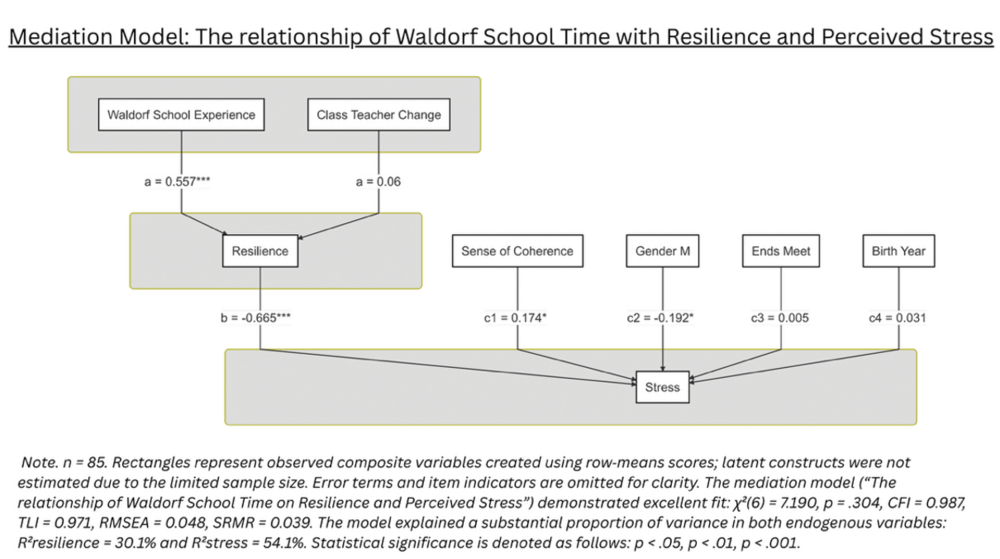
The diagram illustrates a mediation model showing the relationship of Waldorf School experience with resilience and perceived stress, with factors like class teacher change, sense of coherence, gender, and birth year influencing the outcomes. An indirect effect (a × b = −0.370***) highlights a pathway linking students’ time in Waldorf school with their experience of stress.
One of the clearest findings is that graduates who look back on their Waldorf school years with more positive feelings also tend to show higher resilience. Graduates with higher resilience report noticeably lower stress. This statistically significant pathway suggests that positive Waldorf school experiences may help strengthen coping abilities that continue to support graduates later in life. Examining other influences, we found that: changes in class teacher during grade 1 to 8 did not have any statistically significant impact on resilience; Sense of coherence — the feeling that life is understandable, manageable and meaningful — showed a small link to stress, but not in the expected direction; gender played a role: male respondents reported lower stress than others, and age and financial strain did not show any statistically significant effects.
Overall, the model highlights a simple and consistent pathway: Positive Waldorf school experiences → higher resilience → lower stress. This is a robust finding from the pilot study.
Moreover, the model supports the theoretical assumption that contextual characteristics of Waldorf education contribute positively to resilience, which subsequently facilitates coping with stress. Time spent in Waldorf school captures the extent to which students experience consistent teacher support, reliable relationships, and meaningful integration into learning processes.
Methodological note:
This pilot study was based on a relatively small analytic sample (n = 99), the statistical power for estimating complex structural equation models was limited. To ensure stable estimation and avoid convergence problems, the constructs in the model were represented using row‑means composite scores rather than full latent variables. This approach allowed us to test the core theoretical relationships in a simplified and robust way, while acknowledging that latent SEM would provide a more precise assessment in a larger dataset. The pilot results therefore serve as an important first step, guiding the development of a larger-scale survey in which full latent modeling can be implemented.
Across both teacher and alumni perspectives, one theme returns again and again: resilience grows where relationships are meaningful, where environments offer coherence, and where young people feel seen.
The project team
For the survey results of the pilot study with teachers, please refer to our previous article.
Footnote
1: Ungar, M. (2011). The social ecology of resilience: A handbook of theory and practice. Springer Science & Business Media.