From Tension to Encounter:
Rethinking East and West in a Global Anthroposophical Movement
A reflection from Taiwan on dialogue, localization, and the future of anthroposophy
In an anthroposophical online working group, a participant once shared the following image:
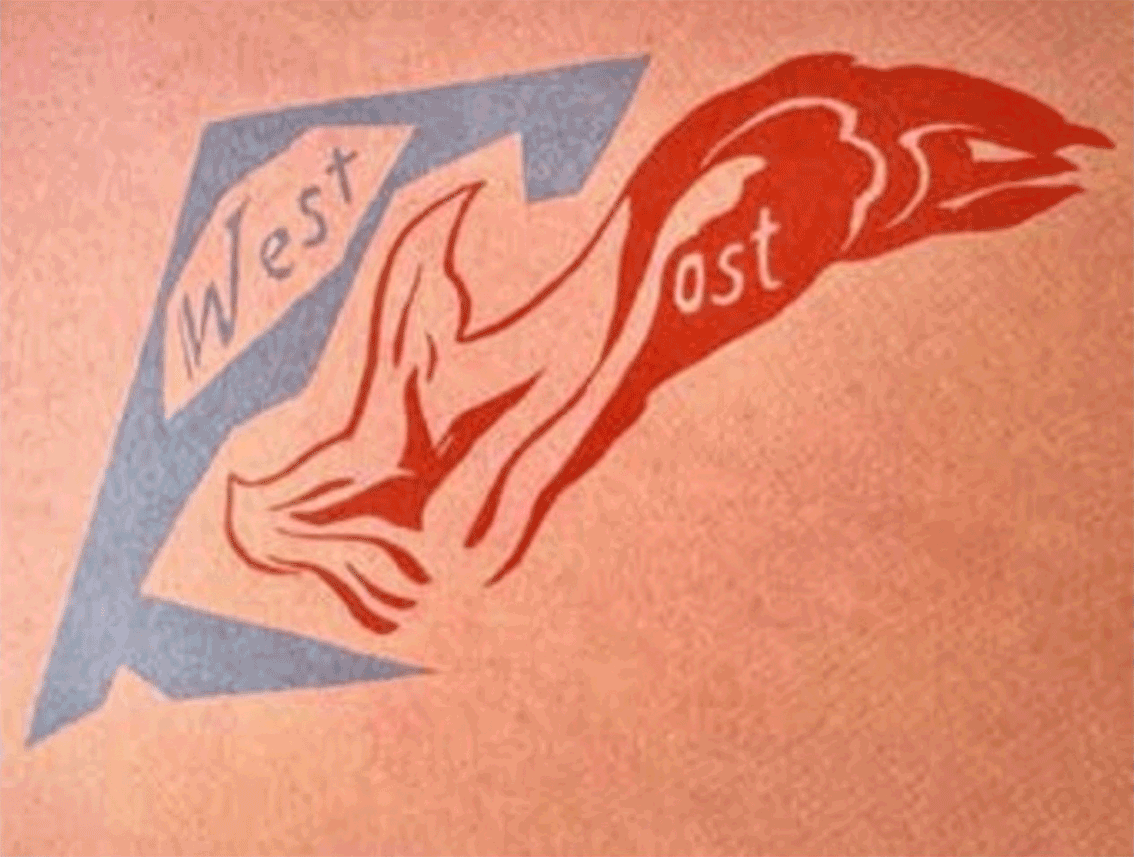
Figure 1. Steiner’s image of East and West (Rudolf Steiner.- “Contrasts Between Western and Eastern Cultures” (GA 83).
On can see a blue, sharply angled, geometric form marked “West” meets a red, flowing, organic form marked “Ost” (East). The two forces encounter one another. When I first saw it, I felt a strong tension.
I do not think we can simply project twenty-first-century assumptions backward and claim to know, from the image alone, everything Steiner intended. Yet another question matters to me just as much: what happens when a person living in Taiwan in the twenty-first century encounters this image today?
I experience two markedly different gestures. One is sharper, analytical, differentiated, and oriented toward clear external form. The other is more fluid, warm, and organic, emphasizing wholeness and inner connection. But this immediately raises a further question: are these gestures really identical to “West” and “East”?
A century ago, such language may have seemed more self-evident. Today we live amid migration, globalization, digital communication, and continuous cultural exchange. A person in Asia may think in ways once described as “Western,” while a European may experience the world in ways once called “Eastern.” For this reason, I have gradually come to understand East and West less as fixed geographical or civilizational identities and more as names for different human tendencies or capacities in approaching reality.
The question then changes. It is no longer: Which will prevail, East or West? It becomes: How might these different capacities meet within a more complete human being?
A Taiji Reinterpretation
With this question in mind, I experimented with transforming Steiner’s image into another form. I retained the two colors, but reconfigured the tense encounter into a form resembling the Taiji diagram.
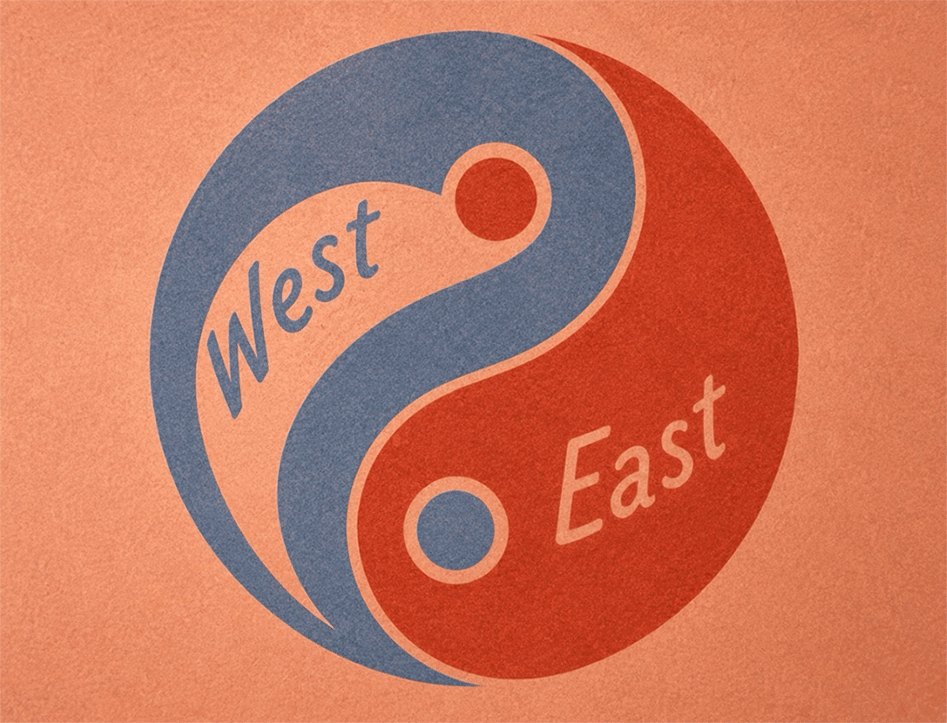
Figure 2. A reinterpretation of the East–West image through the form of Taiji.
For me, this shift is important. Taiji reminds me that apparently opposing forces need not exclude one another. As the familiar saying has it: within yin there is yang, and within yang there is yin. The existence of one pole need not require the disappearance of the other. Indeed, through the presence of the other, each may become more fully itself. This possibility has led me to think differently about the relationship between Asian anthroposophists and the European anthroposophical tradition.
We do not need to reject Europe in order to develop a stronger Asian subjectivity. The European anthroposophical tradition has genuinely nourished many of us and has become part of our own biographies. At the same time, we do not need to silence our cultural backgrounds in order to study anthroposophy seriously. A true encounter does not require us to choose one side and abandon the other.
We can cherish Steiner and still ask him questions. We can respect teachers and predecessors from Europe while also telling them where our experience differs. We can deepen our engagement with anthroposophy while also deepening our understanding of Confucianism, Daoism, Buddhism, Taiwan’s history, Indigenous cultures, and the particular land on which we live. These paths need not be competitors.
Beyond Balance: Toward a Dynamic Spiral
Yet after some time, I felt that the Taiji image was still not sufficient. The traditional Taiji diagram presents a beautiful and complete circle: the two forces have found their places within a balanced whole. But the East–West encounter I hope for does not feel like a finished answer. It needs to remain more open, more historical, and more dynamic.
A real cultural encounter is not simply an arrangement in which “this half is yours and that half is mine.” A genuine encounter changes both participants. When I truly hear another person, I am no longer exactly who I was before. When another person truly hears me, that person may also begin to see something new in themselves.
This led me to imagine a third image: not a closed circle, but a spiral.
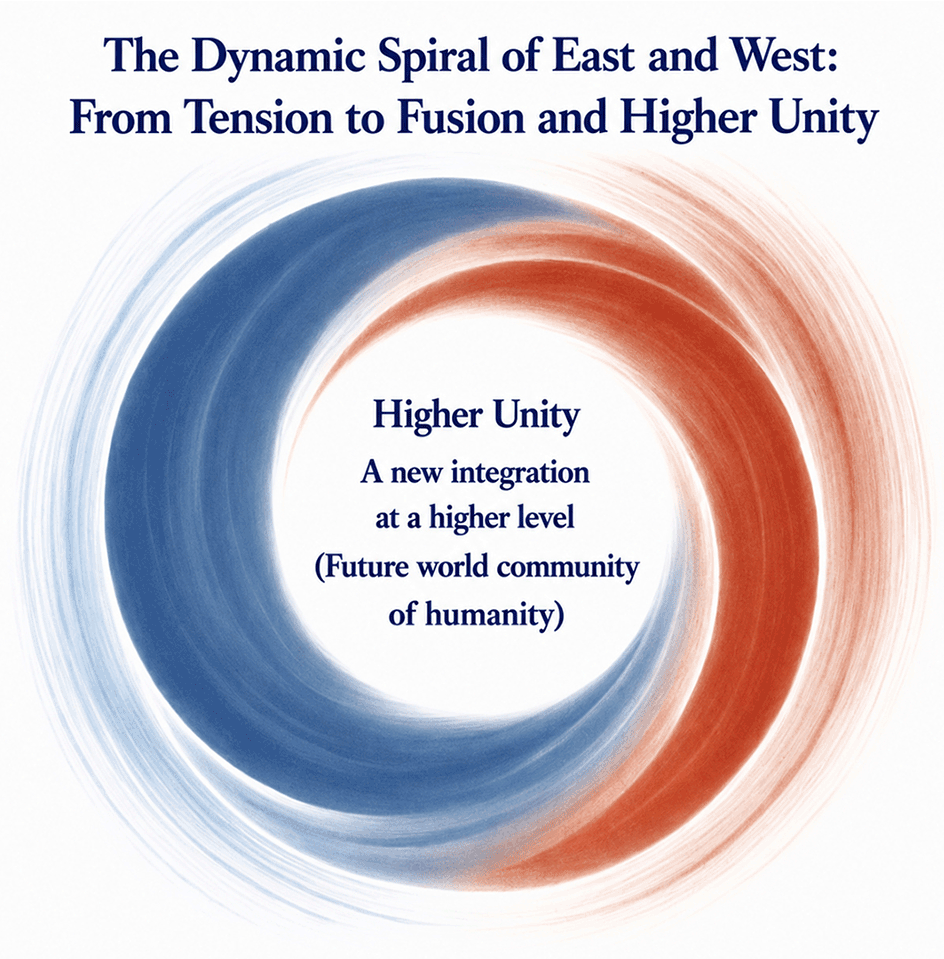
Figure 3. The dynamic spiral of East and West: from tension toward encounter and a higher unity.
In this third image, the two movements no longer merely occupy complementary halves. They turn, interpenetrate, and open outward. I am drawn to the image of the spiral because it has a center without becoming a closed circle. It may return again and again to a similar place, but never to exactly the same place. Every encounter can bring a new understanding.
The “higher unity” at the center therefore does not mean that East and West should be blended into something in which differences disappear. On the contrary, any unity worthy of the name must be capable of holding difference. If only one voice remains at the end, we have not achieved unity; one side has simply vanished.
I imagine higher unity instead as a new relational space: I remain myself, you remain yourself, yet through a genuine encounter something can arise between us that did not exist before. Perhaps this offers one way of imagining a future human community—not a world in which everyone becomes the same, but one in which we learn to live with difference and allow encounters to transform us.
Reading Steiner Across a Century
Such a process also asks something of the way we read Steiner today. Steiner lived in Europe in the late nineteenth and early twentieth centuries, and the great majority of his lectures were given to European audiences. His historical situation, intellectual environment, and the ways in which Europeans of his time imagined Asia, Africa, and other parts of the world differ substantially from our own.
More than a century later, anthroposophy and Waldorf education have spread around the world. Steiner is now read not only by Europeans but by people in Asia, Africa, Latin America, and many other cultural settings. The community of readers has changed, and with it the questions, experiences, and perspectives brought into the conversation.
For me, acknowledging this does not diminish Steiner. I continue to find in his work insights that reach beyond their historical moment and deserve to be rediscovered. Yet fidelity to a living spiritual impulse need not mean carrying every historical formulation unchanged into the twenty-first century. It may also mean testing, renewing, and translating what we have received in the light of new encounters.
If we take seriously Steiner’s understanding of spiritual perception, an important epistemological question nevertheless arises for me: how are spiritual perceptions related to the concrete human individual who receives and communicates them—a person situated in a particular time, language, biography, and culture? I ask this not in order to dismiss spiritual knowledge, but because I want to engage it more seriously, including the human conditions through which it enters history and language.
Respect, in this sense, is not the absence of questions. Sometimes it is precisely because a thought matters deeply to us that we must enter into dialogue with it and be willing to ask difficult questions. And that is what spiritual activities actually mean to me.
Living at the Margins
A friend recently used an expression that has stayed with me: perhaps, unless one belongs to a very particular historical and cultural milieu, all of us in some sense “remain at the margins of anthroposophy.” I have come to find this image of the margin unexpectedly fruitful. It does not need to mean exclusion from a center, nor a lesser degree of belonging. It can name the distance from which understanding, questioning, translation, and new perception become possible.
For me, this marginal position has at least two dimensions. The first concerns Steiner’s own mode of knowing. Much of his spiritual knowledge was presented as arising from supersensible perception. Most of us do not possess such capacities in the same way. We therefore encounter his spiritual research through lectures, books, practices, concepts, and the interpretations of ourselves and others. There is inevitably a distance between direct spiritual perception and our efforts to understand what has been communicated from it. This distance calls not for passive belief, but for patience, continuous inner growth, lived experience, open-mindedness, rigorous testing, and intellectual responsibility.
The second dimension is historical and cultural. Some of Steiner’s formulations emerged in Europe more than a century ago, within languages, assumptions, debates, and civilizational categories different from those of people living today in Taiwan, Japan, India, South Africa, Brazil, Australia, or elsewhere. At times the distance is modest; at other times it can feel like a real gap. Yet neither distance cancels the possibility that something universal and enduring may be present in Steiner’s thought. Indeed, it is precisely because many of us continue to experience such truth and nourishment there that the work of interpretation matters so much.
I have gradually become grateful for this position at the margins. It gives a certain creative freedom. If no contemporary reader can simply occupy Steiner’s original place of perception or his exact historical world, then none of us can claim the whole center for ourselves. We are all, in different ways, readers, practitioners, translators, and participants. The margin can therefore become a meeting place rather than a boundary of exclusion.
Seen in this way, anthroposophy may be imagined not as a closed circle with a single authorized center and distant peripheries, but as a larger and more open field of belonging. People from different ethnic, linguistic, cultural, and historical backgrounds will inevitably understand and practice spiritual science in somewhat different ways. These differences need not weaken the movement. They may form a heterogeneous spectrum within which each person remains responsible for seeking truth while also allowing others the freedom to do so from their own ground.
This changes the task of a worldwide anthroposophical movement. We need, of course, to continue deepening our understanding of Steiner’s work. But perhaps we must take just as seriously the task of deepening our understanding of one another. What does anthroposophy become when it is genuinely encountered in Africa, Asia, Latin America, Oceania, Europe, and North America? How do different histories and spiritual traditions illuminate aspects that another context may not have seen? A worldwide movement cannot be created merely by distributing the same formulations more widely. It must also learn to receive what returns from the many places in which those formulations have taken root.
From Students to Dialogue Partners
This may also mark a new stage in the relationship between anthroposophical communities in Asia and colleagues and teachers from Europe. For many years, many of us in Asia have stood primarily in the position of students: teachers came, we learned; they brought experiences from anthroposophy and Waldorf education, and we worked to understand, absorb, and practice them. This phase has been indispensable, and the capacity to learn from others must never be lost.
But perhaps another movement can now grow alongside it: from predominantly one-way learning toward reciprocal dialogue. Such dialogue does not diminish gratitude or respect. It asks for a form of trust in which each participant can speak from lived experience, question what has been inherited, receive questions in return, and continue seeking truth together.
When a European friend speaks of “the East,” for example, we can respond from lived experience: What do I, as someone living in Asia, hear in this description? Where does it illuminate something real, and where does it fail to recognize the complexity of my culture and history? At the same time, we must be equally willing to let others question our own assumptions.
In such a conversation, people in Asia are no longer merely represented under the broad category of “the East.” We become participants who can speak, respond, question, and contribute from within our own histories. Perhaps we will then ask not only, “What did Steiner think of Chinese civilization?” or “How did Steiner understand the East?” but also: What questions arise when Steiner is read from Taiwan, Japan, India, or other Asian contexts? And from our own cultures and contemporary experiences, what can we contribute to the continuing development of anthroposophy and spiritual science?
From Transmission to Interweaving
This reciprocal movement may sometimes be more than dialogue in the narrow sense. It may involve interweaving, hybridization, and even forms of “crossbreeding.” I use these words deliberately, though not to suggest an indiscriminate mixing in which differences lose their character. I mean that living traditions change when they truly meet. They take in new questions, discover new forms of expression, and sometimes generate possibilities that neither tradition could have produced alone.
Such a process is already familiar in human culture. Languages borrow and transform. Musical forms travel and become something new. Religious and philosophical traditions encounter new landscapes and develop new emphases. Education, too, changes as ideas enter different communities. Why should anthroposophy be imagined as exempt from this living process? If it is a spiritual resource for humanity rather than the cultural possession of one region, then its worldwide future may depend upon its capacity to enter relationships that genuinely transform all participants.
For me, this does not mean relativism. Diversity of interpretation does not imply that every claim is equally true. It means that the search for truth can take place through a plurality of situated perspectives, each of which can be questioned, corrected, deepened, and enriched through encounter. The task is not to protect cultural difference from all criticism, nor to protect inherited anthroposophical formulations from all reinterpretation. The task is to cultivate forms of dialogue strong enough to hold both fidelity and transformation.
Learning to Speak Again
I also carry another hope. To many people outside the movement, anthroposophy can appear closed or mysterious, as though it belongs to a small community with a specialized vocabulary of its own. At times, even among ourselves, we speak in terms that are accessible mainly to those already inside the tradition.
If we truly believe that anthroposophy contains something precious, however, we also have a responsibility to ask how it can enter more open forms of encounter. A person should not first have to adopt an entire anthroposophical worldview before being able to test, experience, or receive nourishment from what it offers. A parent in Taiwan, a public-school teacher, an artist, a farmer, a scientist, a worker, or a young person should be able to meet something meaningful in relation to their own life.
To make this possible, we may need to learn how to speak again: in language that others can understand; through experiences that belong to the places where we live; and in genuine conversation with other educational philosophies, sciences, religions, arts, and cultural traditions. Specialized concepts can be necessary and precise, but they should not become a wall around experience. When an insight has become living knowledge for us, we should also be able to approach it in words that invite others into inquiry.
Learning to speak again also means recognizing that dialogue does not always happen best in the same medium or at the same speed. For people working across languages, a live conversation can sometimes move faster than thought and make precision difficult. Moreover, in many international gatherings and discussions, we often see participants from non-Western regions remain silent. Such silence is not merely the result of language barriers or cultural traits; it also reflects deeper power relations that need to be recognized and transformed collectively. Writing, translation, silence, and delayed reflection can be equally genuine forms of listening and response. A worldwide movement needs room for these different tempos of communication. Hospitality in dialogue includes not only hearing different viewpoints but also allowing different ways of finding the words through which those viewpoints can appear.
An Invitation Rather Than a Conclusion
I do not arrive at the end of this reflection with a complete answer. Perhaps answering too quickly would work against the very process I am trying to describe. I would rather end with an invitation—to friends in Taiwan and Asia, but equally to friends throughout the worldwide anthroposophical movement.
Looking back at the three images, I now see them as stages of an unfinished journey. The first is tension: we recognize difference. The second is complementarity: we discover that difference need not mean opposition. The third is generation: we no longer settle for placing two sides within a balanced circle but enter an encounter whose outcome is not predetermined.
Perhaps the most important thing is not the final, perfect image, but the movement itself: from tension to encounter, from encounter to understanding, and from understanding to new questions. We return again and again, rediscovering both ourselves and others. This is what the spiral has come to mean for me.
We do not all move from the same point toward a single fixed center. We approach from different margins, carrying different histories and questions. Yet through encounter, the margins themselves can become generative. What matters is not that everyone arrive at identical formulations, but that our movement toward truth becomes more conscious, more reciprocal, and more capable of receiving what the other can reveal.
I offer these thoughts not as a position others must accept, but as the beginning of a conversation. I hope that, on our different lands and within our different histories, we can continue that conversation together.
Hornfay Cherng
About the Author
Hornfay Cherng is a co-founder of the Center for Waldorf Education and the Master’s Program in Waldorf Education at National Tsing Hua University in Taiwan. He has been actively involved in the Waldorf education movement in Taiwan and has supported the founding and development of several Waldorf schools. His work also focuses on critically rethinking and transforming higher education in Taiwan, both in its approaches to knowledge and in its educational forms. He explores ways of bringing humanistic and Waldorf-inspired elements into university education in order to foster more holistic and transformative approaches to learning.
hornfaycherng@gmail.com